


August 25, 2026
National Institutes for Quantum Science and Technology(QST)
TOSHIBA CORPORATION
News Highlights
- One of the world's largest superconducting toroidal field (TF) coils manufactured by Japan successfully completed its first excitation test at -269°C, its operating temperature, marking a major step toward the start of ITER operations.
- Demonstrated the effectiveness of Japan's large-scale superconducting coil technology as a key technological foundation for the future realization of fusion energy.
Abstract
One of the world’s largest superconducting※1 toroidal field (TF) coils manufactured by the National Institutes for Quantum Science and Technology (QST) and Toshiba Corporation has successfully passed excitation testing under cryogenic conditions at -269°C. The test replicates the actual operating conditions of the ITER※2 nuclear fusion reactor, and marks a major step toward start of operation of ITER.
The TF coil is one of the most critical components of ITER, the generator of the powerful magnetic field required to confine the plasma. As ITER moves toward the start of operations, a key technical challenge for the project's success is to strengthen the reliability of the integrated system through testing in conjunction with the power supply and cryogenic plant.
In collaboration with the ITER Organization, the TF coil was cooled from room temperature to its operating temperature of -269°C, confirming its transition to the superconducting state. The coil was then successfully energized up to 10,000 amperes for the first time under superconducting conditions. This is the first successful excitation test of an ITER TF coil under superconducting operating conditions. The results validated the manufacturing method used to produce a large-scale coil employing niobium-tin (Nb₃Sn) superconducting conductors, which are highly sensitive to strain. The test also provided key data required to ensure stable operation under cryogenic conditions, including resistive heating at conductor joints and coolant flow characteristics at low temperatures. Both were confirmed to be within the design expectations. Furthermore, no abnormalities, such as coolant leakage during cool-down or energization, were observed, confirming the integrity of the TF coil.
TF coil experts dispatched by QST played a key role in the implementation of the test. Working closely with the ITER Organization and drawing on expertise gained through the manufacture of the TF coils, they led the development of the test plan and contributed significantly to its successful execution.
This achievement demonstrates that Japan possesses world-leading core technologies for large-scale superconducting coils, which are essential for the development of fusion energy. The test also represents a major step toward the start of ITER operations. By supporting the establishment of operating procedures, the training of operators, and the identification of technical issues for risk mitigation, the test will contribute significantly to the integrated commissioning of the ITER superconducting magnet system and help reduce risks associated with future operations.
Figure 1. Superconducting Toroidal Field (TF) Coil Installed in the Test Facility
Development of the ITER superconducting toroidal field (TF) coils
The ITER superconducting magnet system is a massive assembly approximately 30 meters in diameter and weighing about 10,000 tons. The D-shaped toroidal field (TF) coils, 18 of which are arranged in a ring, generate the magnetic field required to confine the plasma (Figure 2). As one of the most important components of ITER, the reliability of the TF coils is essential to the project’s success. Japan was responsible for manufacturing 25% of the TF conductors, all 19 TF coil structures, and 9 of the 19 TF coils.
A TF coil is a large superconducting magnet measuring approximately 16.5 meters in height, 9.2 meters in width, and weighing 310 tons. Each coil consists of a winding pack, which generates magnetic fields of up to 11.8 tesla, and a supporting structure that withstands electromagnetic forces of up to approximately 60,000 tons acting on the inboard side of the coil (Figure 3). The winding pack is made up of seven stacked Double Pancakes. Each Double Pancake consists of a D-shaped superconducting conductor and a radial plate with grooves that hold the conductor in place. The niobium-tin (Nb₃Sn) superconducting conductors used for the TF coils were manufactured by six ITER members: China, Europe, Japan, Korea, Russia, and the United States. The conductors produced by these members, together with the TF coil structures, all 19 of which were manufactured by Japan, were transported to TF coil assembly sites in Japan and Europe. They were then assembled into the completed TF coils.
In 2008, Japan signed a Procurement Arrangement with the ITER Organization for the supply of TF coils. In close cooperation with Japanese industry, QST spent approximately 15 years developing and manufacturing the coils, successfully completing all 9 TF coils assigned to Japan in 2023 (Figure 4). At the start of the project, many experts considered the TF coils to be one of the most challenging components of ITER. Nevertheless, researchers, engineers, and manufacturers across Japan took on the challenge with a shared commitment to realizing fusion energy. The project required a series of major technological breakthroughs. These included achieving millimeter-level precision in the fabrication of extremely large components, developing superconducting technology capable of stably carrying 68,000 amperes under a strong magnetic field of 11.8 tesla, and creating electrical insulation materials capable of withstanding radiation. Through years of dedicated research, development, and manufacturing efforts, each of these challenges was successfully overcome.
The development of TF coils was far more than a manufacturing project. It was a major engineering challenge that combined a wide range of advanced technologies, including large-scale and high-precision fabrication, cryogenic engineering, high-current operation, and high magnetic fields. The successful completion of the TF coils is an important milestone for the ITER Project and a testament to the technological capabilities developed through this international effort. The expertise and technologies established through this effort will provide an important foundation for the realization of future fusion energy.
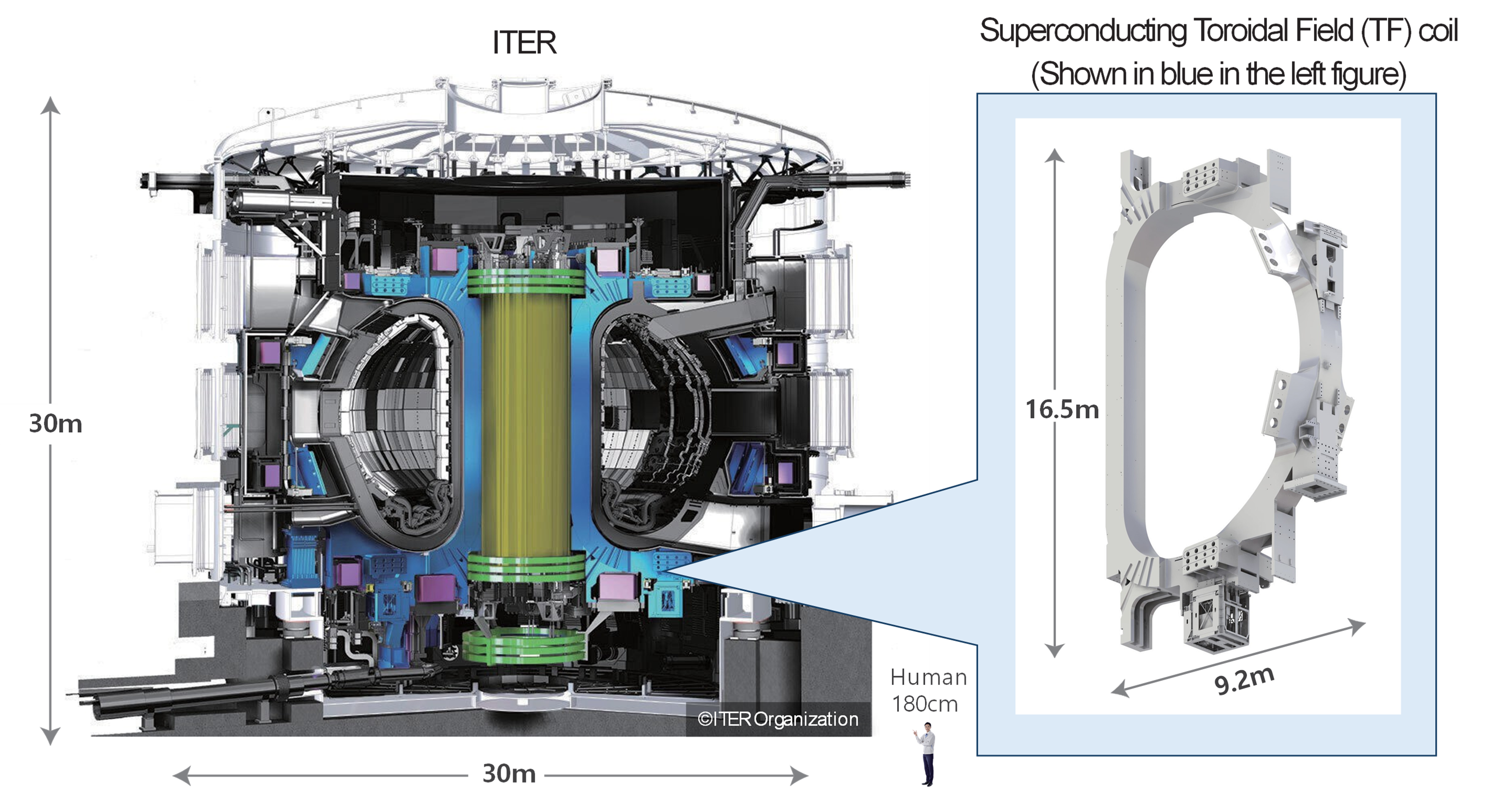
Figure 2. ITER and TF coil
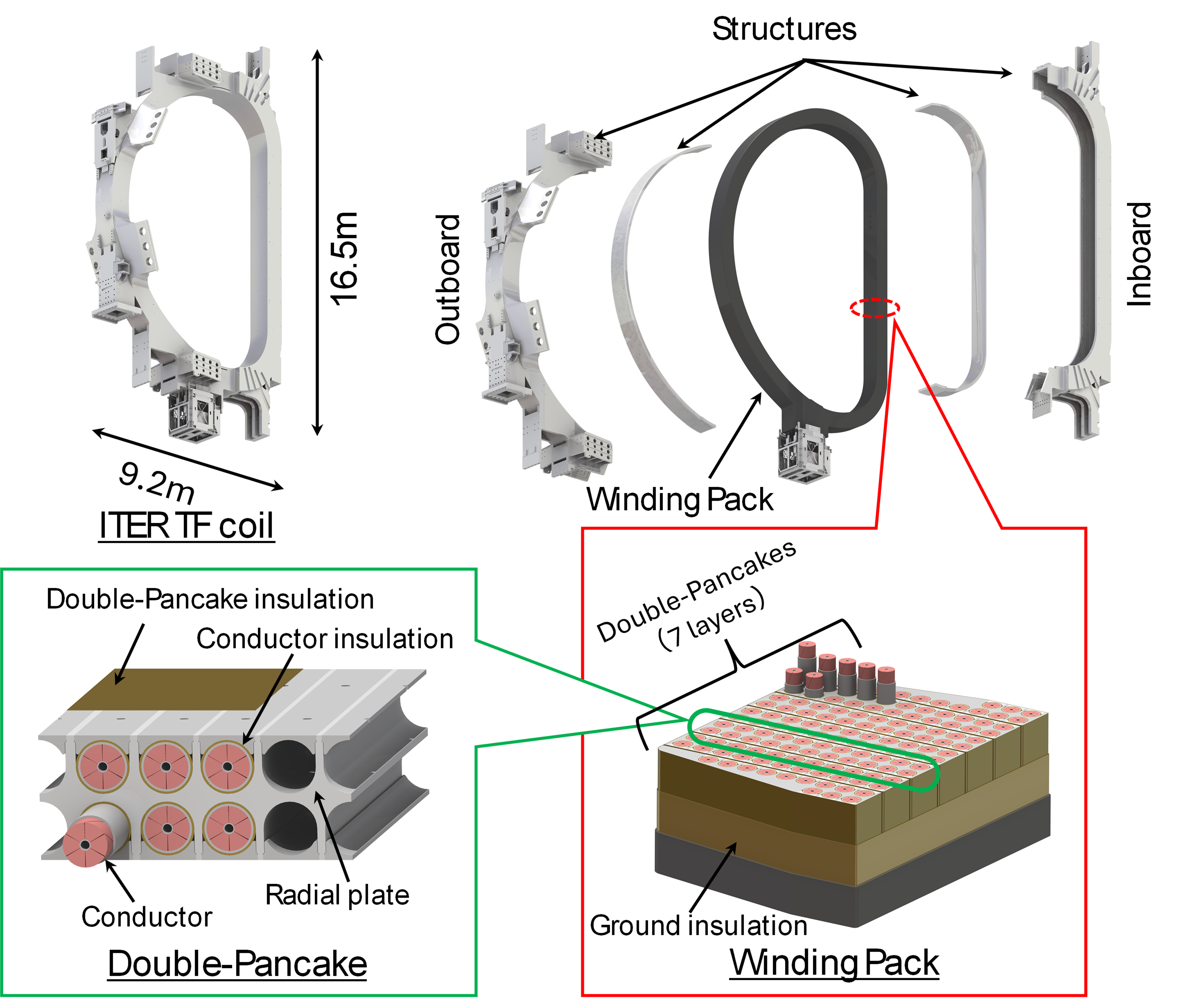
Figure 3. TF coil configuration
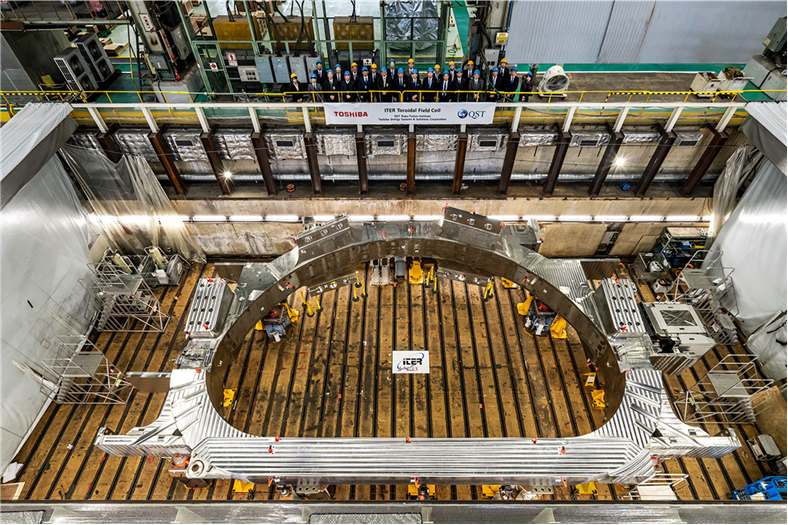
Figure 4. Completed TF coil
Glossary
※1…Superconductivity
-
Superconductivity is a phenomenon in which certain materials, known as superconductors, exhibit zero electrical resistance when cooled to extremely low temperatures. By exploiting this phenomenon and using superconducting materials as conductors carrying large currents, it is possible to generate extremely powerful magnetic fields.
The superconducting conductor used for the TF coils consists of a cable made by cabling together 900 superconducting strands and 522 copper strands, each 0.82 mm in diameter, and enclosing the cable in a stainless-steel jacket. The superconducting material is niobium-tin (Nb₃Sn), which becomes superconducting when cooled below −255°C.
- ※2…ITER
- Japan is contributing to the ITER Project, a global collaboration among 34 countries also representing one of the seven members, aimed at demonstrating the scientific and technological feasibility of fusion energy through the construction and operation of ITER. At the construction site in Saint-Paul-lez-Durance in southern France, assembly of key components is progressing steadily toward the commencement of operations, while the manufacturing of ITER components by the participating members continues to advance successfully.
- URL:https://www.fusion.qst.go.jp/ITER/english/iter.html(English)