


News Highlights
- Integrated commissioning has commenced at JT‑60SA, the tokamak‑type superconducting plasma experimental device (hereinafter referred to as "JT-60SA"), jointly constructed and exploited by Japan and Europe in Naka City, Ibaraki Prefecture, in preparation for its first plasma heating experiments as the world’s largest tokamak. Large milestone has been achieved.
- Starting with tests of the newly installed plasma control coils to improve plasma performance, plasma heating experiments are planned within the year. The experiments will be conducted using artificial intelligence and novel computational techniques, allowing to shorten the time between commissioning and full scale plasma development.
- JT‑60SA will conduct high‑temperature high pressure plasma experiments ahead of ITER, currently under construction in France, and in support of the development of DEMO reactor aimed at demonstrating fusion power generation.
Summary
The National Institutes for Quantum Science and Technology (President: Shigeo Koyasu; hereinafter “QST”) and Fusion for Energy (Director: Marc Lachaise; hereinafter “F4E”) have been supporting the JT‑60SA※1 project through the Broader Approach activities jointly implemented by Japan and Europe. The integrated commissioning※2 of JT‑60SA has now commenced in preparation for upcoming plasma heating experiments.
JT‑60SA is the world’s largest tokamak※3 ‑type superconducting plasma experimental device, jointly constructed and exploited by Japan and Europe in parallel with the ITER※4 project, with the aim to accelerate the delivery of fusion energy. In 2023, JT‑60SA conducted its first plasma experiments, including the control of the largest plasma using superconducting coils. Since 2024, work has been progressing to upgrade the device in preparation for full‑scale plasma heating experiments. In parallel, experiments have been prepared using novel artificial intelligence and computational techniques to speed-up the starting plasma phase.
Thanks to the extensive cooperation between the relevant parties in Japan and Europe, technical challenges have been overcome. Integrated commissioning—testing the newly installed equipment as part of the JT‑60SA system—began on February 27, 2026 (Friday). Starting with tests of the newly installed in-vessel control coils, which will be the world-first experience for large superconducting tokamak, this commissioning phase will continue with the aim of initiating plasma experiments within the year.
QST and F4E will continue to advance their efforts as an international hub for the delivery of fusion energy, while actively applying the knowledge gained from JT‑60SA to ITER and to future DEMO※5 reactors.
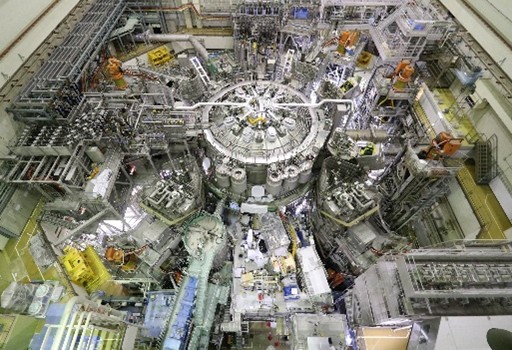
Panoramic View of JT‑60SA
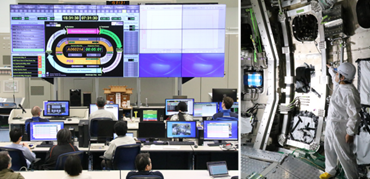
Integrated Commissioning
Left: Control Room, Right: Tested Coil
【Glossary】
※1…JT-60SA(JT-60 Super Advanced)
As a joint project of the satellite tokamak jointly implemented by Japan and Europe as a Broader Approach (BA) activity and the tokamak domestic priority device project that has been under consideration in Japan, the device was constructed at the QST facility in Naka City, Ibaraki Prefecture, Japan. This is the world's largest tokamak-type superconducting plasma experimental device as of today. Its purpose is to support research for ITER to achieve its technological goals and supplementary research for ITER toward DEMO reactors and human resource development. JT-60SA uses powerful superconducting coils cooled to approximately -269 degrees Celsius (absolute temperature approximately 4K) to confine plasma that can reach 100 million degrees Celsius of temperature.
URL: https://www.qst.go.jp/site/jt60/5150.html (Japanese)
※2…Integrated Commissioning
A series of operations carried out to verify the performance of JT‑60SA.This includes operating each subsystem of JT‑60SA, performing vacuum pumping, cooling and energization tests of the superconducting coils, and subsequently generating plasma and confirming its control. Together, these steps constitute the integrated set of operations used to validate the overall functionality of JT‑60SA.
※3…ITER Project
A method of confining high-temperature plasma using a magnetic field: A high-temperature plasma is confined by combining a circumferential toroidal magnetic field produced by the external coils, which is the main magnetic field, with a radial poloidal magnetic field created by passing a circumferential current in the plasma. ITER also uses a tokamak-type device.
※4…Tokamak
With the international cooperation of seven Parties: Japan, Europe, Russia, the United States, China, Korea, and India—the project aims to demonstrate the scientific and technological feasibility of fusion energy through the construction and operation of ITER. The target of the project is to obtain fusion energy that is 10 times larger than the input energy of the external heating system (Q≧10). Currently, the site is in Saint-Paul-les-Durance, France, and the ITER Organization, an international organization for the project implementation, is leading the construction of buildings and the assembly of components for the start of operation. Also, the manufacturing of various ITER component devices has been advanced by each of the seven parties.
URL: https://www.fusion.qst.go.jp/ITER/ (Japanese)
※5…DEMO Reactor
A DEMO reactor is a next-generation device that will be constructed based on the achievements of JT-60SA and ITER and will demonstrate the power generation and economic feasibility of fusion energy. Currently, conceptual designs for DEMO reactors are being developed in various countries around the world.