



August 31, 2026
National Institutes for Quantum Science and Technology(QST)
EUROfusion
Fusion For Energy
News Highlights
- The JT-60SA On-site Laboratory is launched as part of the Japan–EU JT-60SA project, with the aim of enhancing the skills of students and early-career researchers.
- Participants from universities and research organisations based in Japan and Europe, will have a one-of-a-kind opportunity to receive hands-on experience with a large-scale fusion device..
- Through this initiative between Japan–EU we will accelerate the training of the next generation of professionals who will support ITER and future DEMO fusion reactors.
Abstract
The National Institutes for Quantum Science and Technology (QST), Fusion for Energy (F4E), and EUROfusion have fully launched the JT-60SA Onsite Laboratory, as part of the Japan–EU Broader Approach (BA) activities..
JT-60SA is the world’s largest tokamak, designed to complement ITER and to lead research and development toward DEMO reactors. So far, JT-60SA has been positioned as an international project , with intensive efforts devoted to its construction, upgrades, and integrated commissioning. As the project moves toward full-scale plasma heating experiments, QST and its partners are strengthening onsite research and educational activities in order to maximise scientific output while shaping the next generation of fusion experts.
The JT-60SA Onsite Laboratory is a programme under which students and early-career researchers reside at the Naka Fusion Institute and participate closely in research and development activities using JT-60SA, gaining hands-on, practical experience with a large-scale fusion device. Until now, participation has mainly involved Japanese universities and research institutions. With the latest expansion, major European universities and research institutes have begun to take part, marking the full-scale launch of the JT-60SA Onsite Laboratory as a joint Japan–Europe human resource development platform.
This new on-site laboratory builds on the successful achievements of the JT-60SA International Fusion School (JIFS), which QST and EUROfusion have jointly organised over several years. JIFS and JT-60SA Onsite Laboratory form a robust pathway, progressing from structured education through the school to hands-on research through the onsite laboratory. Through this integrated programme, Japan and Europe will accelerate the training of new talent capable of supporting ITER and future DEMO reactors.
QST, EUROfusion, and F4E will actively leverage the knowledge and human network created through the JT-60SA Onsite Laboratory for ITER and future DEMO research, continuing their joint efforts toward the early realization of fusion energy and the strengthening of the global human resource base.
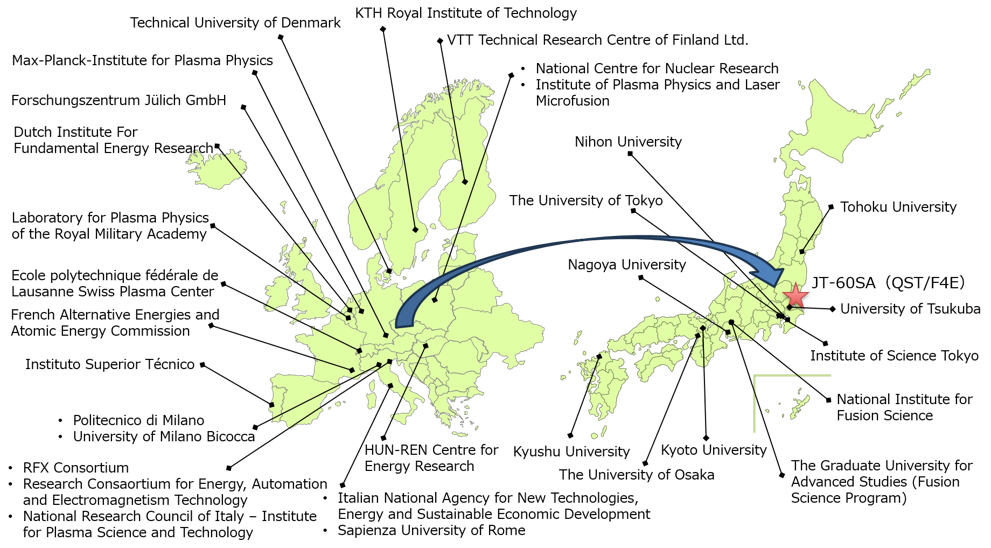
Figure 1. JA-EU participation on JT-60SA Onsite Laboratory
Glossary
※1…Tokamak
- A device that confines high-temperature plasma using a combination of toroidal magnetic fields generated by external coils and poloidal magnetic fields generated by plasma current. ITER is also a tokamak-type device.
- ※2…JT-60SA(JT-60 Super Advanced)
- As a joint project of the satellite tokamak jointly implemented by Japan and Europe as a Broader Approach (BA) activity and the tokamak domestic priority device project that has been under consideration in Japan, the device was constructed at the QST facility in Naka City, Ibaraki Prefecture, Japan. This is the world's largest tokamak-type superconducting plasma experimental device as of today. Its purpose is to support research for ITER to achieve its technological goals and supplementary research for ITER toward DEMO reactors and human resource development. JT-60SA uses powerful superconducting coils cooled to approximately -269 degrees Celsius (absolute temperature approximately 4K) to confine plasma that can reach 100 million degrees Celsius of temperature.
- URL:https://www.qst.go.jp/site/jt60/5150.html (Japanese)
- ※3…ITER Project
- With the international cooperation of seven Parties: Japan, Europe, Russia, the United States, China, Korea, and India—the project aims to demonstrate the scientific and technological feasibility of fusion energy through the construction and operation of ITER. The target of the project is to obtain fusion energy that is 10 times larger than the input energy of the external heating system (Q≧10). Currently, the site is in Saint-Paul-les-Durance, France, and the ITER Organization, an international organization for the project implementation, is leading the construction of buildings and the assembly of components for the start of operation. Also, the manufacturing of various ITER component devices has been advanced by each of the seven parties.
- URL:https://www.fusion.qst.go.jp/ITER/ (Japanese)
- ※4…DEMO Reactor
- A DEMO reactor is a next-generation device that will be constructed based on the achievements of JT-60SA and ITER and will demonstrate the power generation and economic feasibility of fusion energy. Currently, conceptual designs for DEMO reactors are being developed in various countries around the world.