
Realizing dreams and pioneering the future ~ Creating a new Japan, and bringing happiness to the world with Quantum Science and Technology ~
Research and Development at QST— Aiming to Become a World-Leading Research and Development Institute —
QST is committed to contributing to the realization of a sustainable future society in which the economy, society, and the environment are harmonized. We pursue this goal by creating and delivering new value through research and development in the field of quantum science and technology.
In promoting research and development during the Second Mid- to Long-Term Plan period, we have established the following directions and will continue to advance world-leading research and development and generate outstanding research outcomes.
・By leveraging our world-class, high-performance large-scale research and development facilities and their foundational technologies, and by promoting co-creation and shared facility use with researchers in Japan and abroad, QST will lead not only in quantum science and technology but also drive progress across a wide range of scientific fields.
・At our nationally designated research and development centers—including the Quantum Technology Base Hub, the Quantum Life Science Hub, the Fusion Technology Innovation Hub, the Core Center for Advanced Radiation Emergency Medicine, and the 3 GeV High-Brilliance Synchrotron Radiation Facility—we will strengthen human resources, intellectual property, and infrastructure as the core foundation of Japan’s quantum science and technology capabilities.
・Centered on four research fields grounded in quantum science and technology—Quantum Technology Innovation, Quantum Medicine and Healthcare, Quantum Energy, and Quantum Beam Science—we will advance cutting-edge and original research and development.
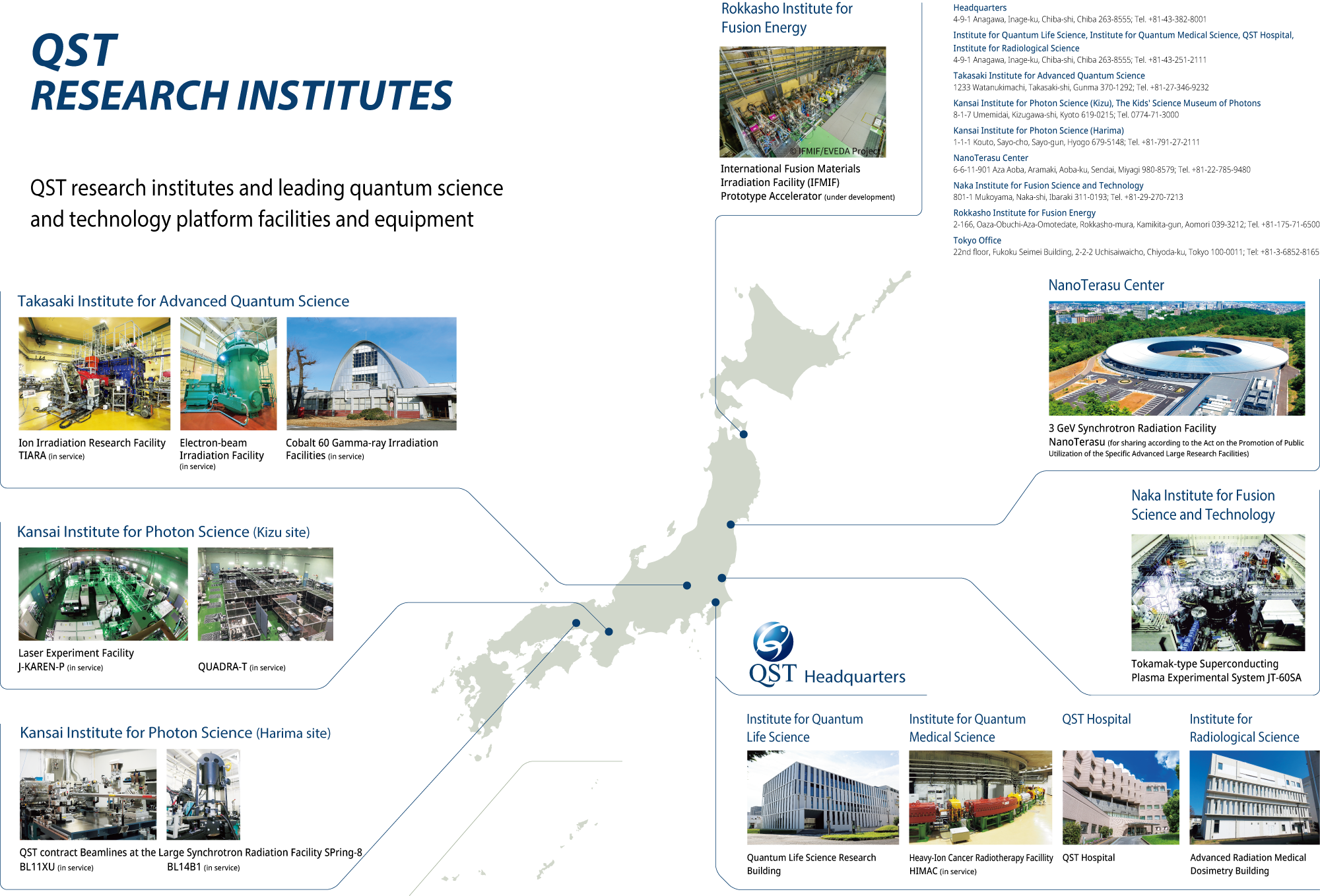
QST has established a system for developing, maintaining, and providing access to a unique set of large-scale research and development facilities, offering a one-stop service that enables efficient use by researchers in Japan and abroad. QST plays an important role in national strategies and policies and has been designated as a core institution for various national initiatives. Through steady and continuous efforts, we will continue to meet the strong expectations placed on us by the government and society.
During the First Mid- to Long-Term Plan period, research was advanced under a framework shaped by the historical background leading up to QST’s establishment, resulting in significant research outputs. In the current Second Mid- to Long-Term Plan period, collaboration and cooperation across the organization have progressed, and further promotion of new integrated and interdisciplinary research is expected.
To this end, we have defined four research fields aimed at achieving a sustainable future society through quantum science and technology, and we are promoting active research activities that span across our research institutes and hospitals.
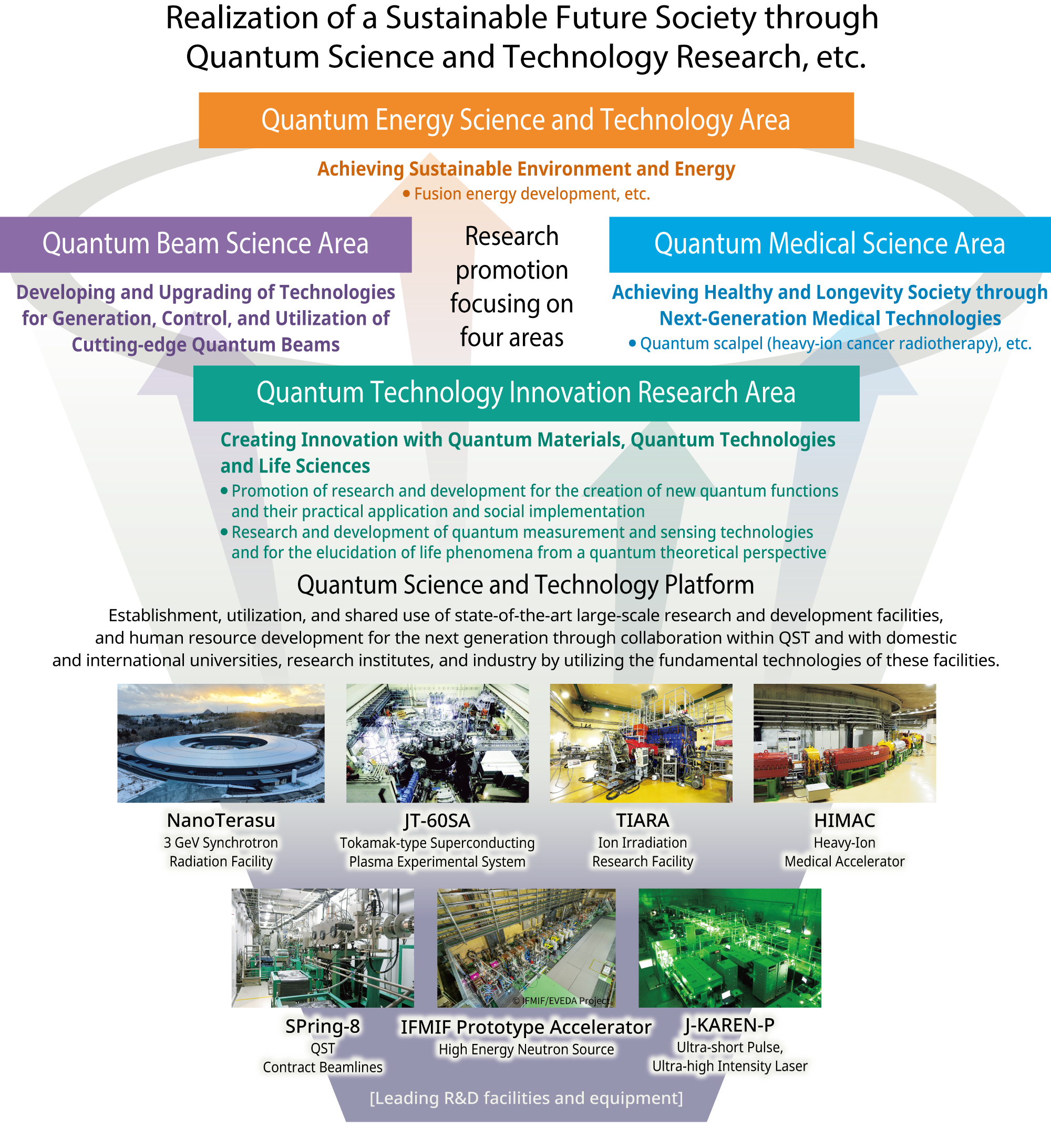
1. Quantum Technology Innovation Research Area
Under the nationally designated initiatives such as the “Quantum Future Industry Creation Strategy,” QST is committed to driving innovation at the Quantum Technology Base Hub and the Quantum Life Science Hub.
1. Quantum Technology Infrastructure Research
We aim to establish key technologies in quantum computing, quantum communication, and quantum sensing, while advancing research and development on essential quantum materials and devices. Through these efforts, we will build a robust quantum technology infrastructure. In addition, we will promote research and development toward creating novel quantum functionalities by integrating cutting-edge photonic technologies.
Furthermore, we will establish a stable supply platform for world-leading quantum materials, thereby accelerating practical applications and social implementation across a wide range of fields.
2. Quantum Life Science Research
By leveraging quantum measurement technologies and conducting research aimed at elucidating life phenomena from quantum-theoretical perspectives, we will advance applied research in the fields of medicine and drug discovery. Alongside these efforts, we will pioneer a new academic discipline that contributes to addressing one of humanity’s ultimate questions: “What is life?”
2. Quantum Medical Science Area
To realize a society of healthy longevity, QST is advancing research and development aimed at establishing heavy-ion radiotherapy as a standard cancer treatment and promoting the social implementation of the next-generation heavy-ion therapy system, the “Quantum Scalpel.” In parallel, we are developing diagnostic and therapeutic technologies for psychiatric and neurological disorders, solid tumors, and multiple or micro-scale cancers.
By leveraging knowledge from quantum life science and radiation effects research, as well as the unique advantage of operating the QST Hospital, we promote seamless research and development—from basic research to clinical studies and actual medical practice. Furthermore, we apply these strengths to research and development that protects the public from radiation exposure. Through the development and implementation of exposure treatment technologies, dose assessment techniques, and related innovations, we contribute to building a resilient society capable of responding effectively to various radiation emergencies.
3. Quantum Energy Science and Technology Area
With three core pillars—the promotion of the ITER Project, which aims to demonstrate the scientific and technological feasibility of fusion energy through international collaboration; advanced plasma research and development, which studies sustaining fuel burning in a reactor; and fusion engineering and technology research and development, which supports the realization of high‑quality plasmas—QST is comprehensively advancing its research efforts.
These activities include the construction of ITER, the International Thermonuclear Experimental Reactor, as well as the operation of the JT‑60SA superconducting tokamak plasma experimental device at the Naka Fusion Institute, which serves as a precursor to ITER.
4. Quantum Beam Science Area
QST advances the development and enhancement of technologies for the generation, control, and utilization of quantum beams—including ion beams, electron beams, lasers, and hard and soft X‑ray synchrotron radiation—and promotes the shared use of its world‑class, uniquely high‑performance quantum beam facilities by researchers and engineers in Japan and abroad, as well as collaborative research. Through these efforts, we drive leading research and development across a wide range of fields, including engineering, biology, and medicine, while also fostering new forms of co‑creation.
Regarding the 3 GeV high‑brilliance synchrotron radiation facility NanoTerasu, QST works in collaboration with regional partners based on public–private regional partnerships. Together, we support its development and operation and promote its shared use in accordance with the Act on the Promotion of Public Utilization of the Specific Advanced Large Research Facilities.
QST aims to create a sustainable future society by contributing—through its research and development activities—to Japan’s economic growth driven by productivity innovation and the creation of new industries; to the realization of a healthy and long‑lived society through overcoming cancer, dementia, and other diseases; and to green transformation through the achievement of carbon neutrality and a circular economy.
Dr. Koyasu Shigeo
President
National Institutes for Quantum Science and Technology